Management Research Services Unites With American Enterprise Group

AEG+website

.

MRS – AEG Partnership Press Release

.

American Enterprise Group, Inc. (AEG) announced today it will be partnering with Management Research Services, Inc. (MRS), a global leader in insurance automation and technology solutions, announced today the release of a new electronic application system for life and health insurance policies.  The new technology will allow insurance professional to complete and submit application for straight through processing and instant policyholder decisioning. The platform will allow for real-time processing 100% in-good-order applications. This partnership will empower the divisions of AEG to service and offer real time policy issuance to our distribution and policyholders.

.

The partnership with MRS is a part of an ongoing, companywide focus on innovation within AEG, and is a result of an earlier interaction with American Enterprise Ventures, LLC, which is a venture capital company backed by AEG that focuses on investments in early-stage startups in the insurance, finance, and healthcare industries.

.

“Representatives of American Enterprise Ventures discovered MRS at an innovation summit and were impressed with the new technologies the company offered,” explained Julie Larson, Chief Technology and Innovation Officer. “We were looking for a new rules and application processing platform to better meet our growing needs, so the American Enterprise Ventures team brought the potential solution to company leaders for further vetting. It was a great find for us.”  Brad Darnell, MRS Chief Technology Officer, says “At MRS we look for partners, not clients, and we could not have asked for a better one than AEG. Right from the beginning, we have developed a strong relationship with great collaboration between our organizations. This teamwork has led us to a multi-phased product rollout strategy in a short amount of time. Our approach not only supports AEG’s digital transformation goals but is also driving exciting innovation to our platform. We are grateful every day for the partnership that has been developed with this excellent company.”  GG Oncel, MRS Head of Customer Strategy & Growth, says “MRS is proud to have been chosen as the exclusive partner of AEG for its digital transformation efforts across product lines and distribution channels.  The teamwork between the two companies has been excellent resulting in an implementation process that has moved forward with great speed and efficiency.  The MRS No-Code platform has proven again that it can support highly complex application processes at any level of volume needed.  MRS places significant value in its partnership with AEG and is excited to showcase it to show how we can support the larger tier carriers in the US market and beyond.”

.

About American Enterprise Group, Inc.

.

American Enterprise Group, Inc., has multiple insurance company subsidiaries under the American Republic®, Great Western Insurance Company (GWIC®), and Medico® brands. These companies offer life and health insurance product solutions to help people secure their financial futures through various distribution channels and are licensed in 49 states, plus the District of Columbia. American Enterprise is based in Des Moines, Iowa, and employs approximately 450 people in its Des Moines, Iowa; Omaha, Nebraska; and Ogden, Utah, offices.

.

About American Enterprise Ventures, LLC

.

American Enterprise Ventures, LLC is a venture capital company backed by American Enterprise Group, Inc. American Enterprise Ventures’ investment strategy focuses on early-stage startups in the insurance, finance, and healthcare industries. With initial investments of up to $1 million, American Enterprise Ventures’ funds are typically made in seed to Series A round startups. For more information visit www.americanenterprise.com/aeventures.

.

About MRS

.

At MRS, we help clients transform change into a competitive advantage.  MRS provides a high-end technology product to life, health, and annuity insurance industries.  In today’s world where “the only thing constant is change,” that original vision has been expanded to include more services and technology capabilities designed to help clients adapt quickly and in a cost-effective way.  MRS has invested heavily in our technology platform to create a foundation for the next revolution in life insurance.  MRS’s No-Code platform gives you all the tools needed to build a highly secure, complex application that efficiently collects voice and electronic data without writing a single line of code.  The result is a vastly reduced time to market with no initial or ongoing maintenance costs making the total cost of ownership substantially lower than status quo solutions.  Our platform’s ability to support powerful reflexive logic makes the MRS rules engine extremely efficient in collecting all information needed to make a point-of-sale decision.  The capabilities and flexibility of our platform allow customers to use the MRS technology platform as their single solution or as a tool to support and enhance current technology solutions they already have in place.  For more info on MRS product e-Apps, please email GG Oncel at gg.oncel@mrsreps.com or visit the website at www.managementresearchservices.com.


The Rise of Platforms

…And what it means for the life and annuity sector

.

May-1-Essick-Tech

.

by Matt Essick

Mr. Essick is Chief Marketing Officer for Ensight™, a sales and data acceleration provider specializing in the insurance carrier and national-distributor space. He spent a decade as a marketing strategist for the Zurich Insurance Group, U.K. and participated first-hand in the rise of digital platform distribution models. Visit Ensight here.

.

The era of the platform economy is here.

.

Actually, it has been here for a decade or longer.

.

Think Apple, Google, Airbnb, Microsoft, Uber, Amazon, Square, LinkedIn, Lyft, Facebook, and Tesla.

.

The majority of the most valuable companies globally are now based on a platform business model, which is defined as: “the creation of digital communities and marketplaces that allow different groups to interact and transact”.

.

And in the financial services space?

.

Let’s name just a few – Robinhood, Envestnet, eMoney, Acorns, Oscar, Xero, RightCapital, Personal Capital, Avant, Blend, Chime, Brex, BrainTree, Enfusion, Verifi, Circle, Opploans, Transferwise, Venmo, Gravity Payments, Coinbase, etc etc. The list goes on and on.

.

Fintech platforms are remaking the financial services industry. Redefining the “experience” of every corner of financial services. And thus, redefining expectations, across the value chain, from manufacturing to distribution to consumers. The broad principles of the Fintech platform era:

.

– Ecosystems and connectivity are key

– Customers now engage product manufacturers through “platform distribution”

– User experience (UX) is fundamental to acquisition and retention

– At scale, Fintech platforms change industry dynamics

– Winners (and survivors) adapt their business model quickly

.

And so, what does this mean for the Life and Annuity sector?

.

Some Predictions for the Life and Annuity Platform Era

.

Predictions are always a dangerous game. But if one takes the broad dynamics of platform-based economies as largely constant through every sector, we can also look into the near future for the Life and Annuity sector.

.

Here are three predictions over the next decade:

.

– Life, Annuity and LTC business origination (new business) will proportionately and dramatically shift towards multi-carrier distribution platforms

– Life and Annuity distribution will consolidate onto 3-5 leading “mega-platforms”, owning over 50% share (*similar to financial planning software landscape)

– Distribution focus will shift from traditional, back-office “agency management platforms” to field technology “sales enablement platforms”

.

Perhaps the grandest prediction is that digital platforms, independent of proprietary development and ownership by insurance carriers and distributors, will become true power brokers in the industry.

.

The implication? Perhaps, Geoffrey G. Parker, a Dartmouth College professor and Massachusetts Institute of Technology (MIT) research fellow, said it best:

.

“The bulk of the power in industries is likely to shift to ecosystems… So, the message is every firm needs to understand platforms and figure out their place in the industry structure that is coming”.[2]

.

Unstoppable Drivers Towards Platform Distribution

.

There are several unstoppable forces and accelerants now at play.

.

Each of these trends, in and of itself, is enough to shift the structure of the sector. However, when one considers all five in the aggregate, the emerging future is a foregone conclusion.

.

Consolidation in Distribution: 
Consolidation is at hand in the Life and Annuity distribution landscape and will only accelerate from here. Whether we are talking about LifeMark and Bramco joining together to create LIBRA, or the acquisitions made by the PE-backed national players (e.g., Simplicity, AmeriLife), the future of distribution will look very different. One thing is for sure, technology platforms play a critical role in the integration of firms.

.

Staggering Investment in Fintech:
 Global fintech investment reached $44 billion in 2020[3], an increase of 14% from 2019. The scale of investment in Fintech platforms is staggering – and insurance carriers and distributors will simply not be able to compete with a legacy internal development (“build” vs “buy”)” mindset. If nothing else, $44 billion definitively underscores the fact that we are in the age of fintech and insurtech platforms.

.

The March to Best Interest (BI): The Life and Annuity sector is on a continued trajectory towards a Best Interest (BI) centric regulatory environment. While this may differ by channel, a rapidly growing number of distributors are choosing to err on the side of a fiduciary model. This means suitability standards, illustrating different product options, and capturing auditability along the way. There is only one way to accomplish this efficiently and cost effectively – a technology platform (*not paper).

.

New distribution Business Models: The traditional distribution business model within the Life and Annuity sector is changing. There is a growing focus across several fronts: automating back-office processes; shifting time and focus to field-oriented sales enablement; and, extending a digital platform to financial professionals for advisor-centric “self-service”. This is the strength of technology firms.

.

The weight of market expectations: Every single financial services experience today is digital, visually intuitive, interactive and easy to understand. Every single one – except the life and annuity sales experience. Moreover, every single core stakeholder group in the value chain now expects this modern digital experience, from employees to financial professionals. Let’s remember, millennials now represent the largest workforce in the economy today.

.

These drivers are irreversible. To borrow a phrase from the noted American journalist Sebastian Junger – this is the “perfect storm”.

.

3 Recommendations To Win

.

So how can Life and Annuity insurance carriers and distributors adapt and win? I have three recommendations to start.

.

Develop a platform-led distribution strategy

.

Every carrier and distributor should now be thinking about how this emerging context will impact product development, distribution profitability and the market-facing business model.

.

There are several long-term strategic questions to be debated. Here are just a few:

.

– Business origination: What will be the impact on new business origination? Will closed, proprietary service channels remain at scale in the future?

– The wholesaling operating model: What is the future model of wholesaling? How will wholesalers engage with the channel?

– Channel strategy: Where will my target customers be, and how will I reach them? Will I need to access those customers on a 3rd party platform, or can I provision a platform to (capture) them?

– Profitability: How will I drive profit and scale in this new era? Which channels will see an erosion of profitability? What new target operating model may be required to maintain ROE?

.

These are fundamental questions that need to inform distribution strategy over the next decade. Without addressing these critical questions (and others), insurance carriers and distributors will be flying blind into the “perfect storm”.

.

Expect to see a few casualties.

.

“Get on” the dominant platforms early

.

It is simply not possible to compete with $44 billion in fintech platform investment.

.

The old “build vs. buy” debate is a different question today. If you are an insurance carrier or national distributor, choose wisely what you elect to “build” rather than “buy”.

.

An emerging dynamic of the platform economy is the ecosystem. It is critical to buy the flexibility to thrive in an ecosystem. The leading fintech and insurtech platforms bring connectivity and pre-built integrations to the table.

.

There are two other central reasons to adopt the dominant emerging platforms early, and ahead of your competition:

.

First, you can ride the opportunity of a “network effect”. A network effect refers to a situation in which the value of a product, service, or platform grows based on the number of buyers, sellers, or users who leverage it. Leading distribution platforms will be rapidly growing the number of customers you can reach – through one efficient digital channel. (Of note, it becomes increasingly painful and inefficient to do business outside of a platform network as well.)

.

Second, it is impossible to understand how these platforms work ‘in practice’, on a day-to-day basis, the subtle nuances – unless you are actually also utilizing the platform itself. For a carrier, this means potentially being one step-removed from understanding how its products are actually sold, why they are selected, and how to win business.

.

Smart counsel today is to adopt and use best of breed” third party platforms early on.

.

Play to win and embrace the change

.

The Life and Annuity sector today falls into two camps: Early adopters (change embracers) and late adopters (change laggards).

.

Waiting to adopt emerging technology used to be wise counsel. But in the era of Moore’s Law, this is no longer a recipe for winning.

.

Digital innovation “lead time” or “cycle time” is becoming an increasingly deciding factor in the emerging winners and losers. And the stakes are higher than ever.

.

One might say that embracing digital platforms has “compounding returns”. Competitive advantage can double, or quadruple based on an organization’s digital fitness.

.

Understanding the dynamic of new distribution technology platforms – and how to win on these platforms – takes time. Players who adopt first, stand to benefit from those compounding returns and will be well positioned for market-leading growth and profitability in the decade ahead.

.

1 The Platform Economy, The Innovator, Jennifer Schenker (https://innovator.news/the-platform-economy-3c09439b56)
2 The Platform Economy, The Innovator, Jennifer Schenker (https://innovator.news/the-platform-economy-3c09439b56)
3 The state of FinTech: a recap of 2020 and a glimpse into 2021, FinExtra, 2/8/21 (https://www.finextra.com/blogposting/19849/the-state-of-fintech-a-recap-of-2020-and-a-glimpse-into-2021)

How Insurance Distributors Can Provide Transformative Solutions to Advisor Productivity

LOGO EQUISOFT-2017_RGB - nomargin

The distributor opportunity to transform advisor practices

.

The insurance distributor value proposition for advisors is built on a foundation of helping remove the barriers that restrict practice growth, create headaches and lower profitability. They already do a great job providing case management support, marketing support and access to carriers, but there is an overlooked opportunity to unlock advisor productivity and strengthen relationships.

.

The opportunity arises from a very specific advisor challenge.

.

The insurance advisor challenge: when growth outstrips inefficient processes

.

Financial advisors seeking to dramatically increase the value of their book of business do a great job of creating plans for finding more prospects and meeting more of each current client’s needs. They look for ways to optimize processes, improve productivity and drive agency growth.

.

However, even advisors who have set a clear vision and defined a plan for achieving their growth targets can run into trouble when growth outstrips processes. The irony is that, it’s all too easy for advisors to enjoy growth in their business, but then see it choked off because of workflow-related obstacles and slow-downs. Sometimes it’s the simple problems that shut down grand ideas.

.

Download the full case study. Click here.

.

Despite all the work an advisor may have done to put staff, structure and systems into place to kick-start their growth engine—if they are still reliant on manual, paper-based approaches to uncovering client needs, too much time is spent on each step in the sales process with each client.

.

Equisoft-Plan-Divider-Compass-Tool-1920x1080

.

Why legacy financial planning software can create its own bottlenecks

.

Financial planning software tools provided by carriers and vendors at some point in the past, are better than relying on jury-rigged Excel solutions, but it’s still not always good enough. Older solutions are less automated, and still require too many manual steps. They may be able to get the job done, but are cumbersome to use, don’t integrate with existing CRM and distributor or carrier systems, and require double entry of client data.

.

It’s not unusual for an advisor’s assistant to spend 45 minutes collecting information from a client and entering it in their older, financial planning software tool. And then, the advisor may still need to review the results and tailor the recommendations.

.

Accelerating the in-flow of new prospects brings with it a corresponding increase in the number of client discovery initiatives. And this turns out to be a cap on growth for some advisors. The math is simple; the amount of time each discovery takes, times the number of clients. Once that number becomes larger than a few hours a day, it’s like turning the advisor’s practice into a headwind. Everything slows down. Becomes hard. At a certain point, prospecting becomes secondary, and the growth curve flattens.

.

These bottlenecks mean that advisors are reduced to making money in their business based on the time they can spend with a client (which is a limited resource) rather than based on the value they can deliver.

.

Largely manual or inefficient processes create a form of business risk. Especially in a competitive marketplace where growth and being able to carve out a significant niche are vitally important. What advisor in the prime of their career would be satisfied with just maintaining their status quo?

.

How distributors can provide transformative solutions for advisors that want to increase productivity

.

The answer isn’t for advisors to hire more staff in an attempt to accommodate manual processes that are suffocating growth. Instead, this is an opportunity for distributors to deliver significant value for their advisors by providing an effective solution for eliminating roadblocks.

.

To find out more, read the case study

.

Insights Author

Charles-Pedneault

Charles Pedneault

Vice President, Insurance Distribution Solutions

See more insights from Charles

Contact Charles

.

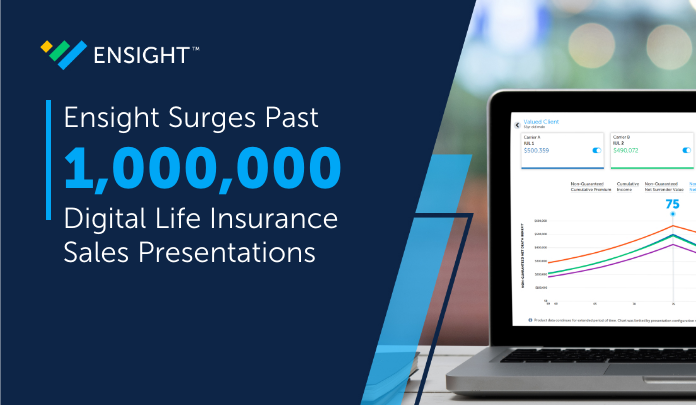
Ensight™ Surges Past One Million Digital Life Sales Presentations

ensight-surges_53250194-2

The company’s cloud-based sales experience platform is now servicing over 250,000 financial professionals across the U.S.


SAN DIEGO, CA, March 17, 2021 — Ensight™, the market leading life, long-term care (LTC) and annuity digital sales acceleration platform for insurance carriers, distributors and financial professionals, today announced that over one million digital sales presentations have been generated on its insurtech platform. Ensight’s growth rate also continues to compound, driven by an increase in remote selling, the hybrid wholesaling transformation shift and emergence of the “digital agent” model. Today the platform works with over 250,000 financial professionals.

.

“Every financial services sales experience today is digital, interactive, visual and easy to understand – whether that is the leading financial planning software used by advisors, or the investment management and 401K portals now experienced by the consumer. Life, annuities and long-term care are the only remaining financial product areas out of step with today’s digital experience expectations,” said Bill Unrue, CEO, Ensight.

.

The COVID-19 pandemic has acted as a digital catalyst over the past year, as life and annuity insurance carriers and distributors have had to adapt to a virtual (remote) sales operation. This business response is also now accelerating a permanent transformation to a “hybrid wholesaling” and “digital agent” sales and service model. Wholesaling transformation, in particular, offers the sector an opportunity to achieve travel and entertainment (T&E) budgetary savings, while driving improved wholesaler productivity, more flexible advisor servicing, and better product marketing through digital education.

.

The Ensight sales acceleration platform was launched in 2017 to help modernize and transform the sales experience for life and annuity insurance carriers, distributors, financial professionals and consumers. Ensight simplifies the complexity of the permanent life insurance (GUL, Whole, UL / IUL, and VUL), LTC and annuity sales engagement into an intuitive, consumer-friendly digital experience. The platform leverages data visualization and rich content to create a modern interactive sales discussion, which has underpinned the rapid shift to virtual (remote) selling during the COVID-19 pandemic. Over 250,000 financial professionals, including insurance agents and advisors, now use Ensight to better explain how a permanent life insurance or annuity product works and interactively demonstrate product features, such as cash value accumulation, rates of return and policy charges.

.

“The life and annuity sales model is at a once-in-a-generation inflection point. From the internal sales desk and wholesaler-advisor channel to the client’s point of sale experience, the entire value chain of the traditional sales model is being structurally reorganized and digitally redefined,” said Nathan Jacobson, Executive Vice President (EVP), Life Insurance, Simplicity Financial Group. “Ensight is the clear market leader today, enabling modern, interactive sales presentations that simplify the wholesaler-advisor-client discussion of complex permanent life, LTC and annuity products.”

.

To learn more about Ensight and its digital sales acceleration platform, visit www.ensightcloud.com.

.

About Ensight™
Ensight™ is the leading cloud-based insurance sales acceleration platform for more than 500 Life and Annuity distributors, thousands of financial professionals, as well as many of the largest North American insurance carriers. Headquartered in San Diego, California, Ensight helps drive sales growth and productivity, while addressing the entire sales lifecycle experience – from prospect to policyholder, new business to inforce.


Lingering Cloud Fear And Adaptation

Blog+Image+#9+website

.

Lingering Cloud Fear and Adaptation

.

Nephophobia is the fear of clouds. It’s thankfully rare: clouds are tough to avoid. The ancient Greeks were talking about storm clouds. Fear of cloud computing is a more recent development; a by-product of forced adaptation. In 2021, 94% of the internet’s workload is processed by cloud data centers. Just two years ago, this figure was 60%. How did cloud use become ubiquitous so quickly?

.

A little bit of history puts the revolution in perspective. The appearance of “The Cloud” in our lexicon is recent. The earliest usage was in 1996 when a Compaq public-relations piece used “cloud computing” to describe enhanced utility of the world wide web. The men who co-authored the piece both claim to have coined the term. (One of them even attempted to copyright “cloud computing” in 1997, but to no avail.) In 2006, Google and Amazon started describing the new paradigm where users access software and files over the internet (instead of their desktop) as “cloud computing.” Right then it became the hot new buzzword.

.

The marketing guys from Compaq in the ‘90s had it right. The Cloud is not new; it is what the web was designed to do since it was created in the 1960s. It’s a simple re-branding of the internet; a fitting metaphor for a changed system to where everything is accessed and stored remotely.

.

Skepticism and suspicion have been mostly quelled by how rapidly the world migrated. Cloud computing is globally pervasive: 85% of businesses worldwide use cloud-based data storage. 77% of companies have an application running on a cloud-based server. It’s the new normal.

.

The remaining objections to cloud computing.

.

The upside is undeniable – reduced cost of operation, greater flexibility, and improved collaboration. The benefits far exceed those of older-generation physical servers. Years ago, objections to cloud migration were often related to human readiness or organizational support. Too new and unknown. Today, we are through the looking glass on such fears. The remaining objections for migrating to the cloud are mainly two: cost concerns and privacy concerns.

.

Though commonly used as an objection, saving money is the most popular reason businesses migrate to the cloud: 61% of businesses say “cost” is their primary reason for adopting cloud use versus just 30% who migrate for the “additional storage.” The storage aspect saves money, too: cloud hosts charge you for the just the space you use. Think of how this contrasts with the IT specialists of yesterday purchasing equipment with tomorrow’s storage needs in mind. No more wasted storage space or hardware growing obsolete. In a recent study, 82% of businesses that migrated to cloud systems reported cost savings that covered any initial up-front migration fees within six months of the switch.

.

The privacy concerns might be more about control. Knowing where the data was physically housed was of a certain comfort; moreover, we knew the guys on the IT team. They know their stuff, right?

.

Not to say they didn’t, but in 2021 the three largest providers of cloud services are Amazon, Microsoft, and Google. Each has security knowledge, intel, and experience that dwarfs almost every organization’s. It’s what they do. The proof is in the pudding: 94% of organizations report fewer security incidents after migrating to cloud-based alternatives. Less resources devoted to maintaining system security means more savings.

.

MRS: cloud-based solutions for providers and 3rd party administrators.

.

Management Research Services (MRS) operates their no-code insurance services platform on Microsoft Azure, a top-tier cloud solution for SaaS (software as a service) applications. Data encryption combined with Microsoft’s dedication to robust security means the sensitive data managed within our application is always secure. Using Microsoft Azure to host the MRS platform and e-App allows us to focus on what we do best: designing state-of-the-art insurance service interfaces that best serve our clients and their customers.

.

Contact the staff at MRS to learn about trying a demo of our latest products. We are ready to put our cloud-based solutions to work for you. Request a demo here, or email us at: sales@mrsreps.com.

.

Catholic Order of Foresters Modernizes With WELIS Ascent Illustration System

ipipeline 1

.

New Platform Enables Agents to More Effectively Present Products to Consumers

.

Exton, PA (April 13th, 2021) – iPipeline®–a leading provider of no code / low code cloud-based software solutions for the life insurance and financial services industry–today announced that Catholic Order of Foresters has selected its WELIS® Ascent illustration system to modernize how their agents present diversified insurance products to consumers seeking protection.

.

The WELIS Ascent illustration system is a scalable platform, designed to help insurers sell and service customers in a multi-channel distribution environment. The award-winning software is constructed as a standard single life illustration system that can be transformed into a sophisticated multiple life / multiple plan system with a single button click. iPipeline acquired WELIS in September 2020 and is one of the largest providers of illustrations in the life insurance industry.

.

“Educating consumers about what they are buying and how it is likely to perform in the future is critical to selling life insurance products. Automating the task of providing detailed illustrations to consumers not only enables agents to more effectively sell but allows them to show the differences more effectively across a range of products. Agents need to ensure that they are clearly educating consumers about products shaping their financial futures. Our platform fulfills this important need,” said Larry Berran, CEO, iPipeline. “WELIS Ascent is a feature-rich illustration platform offering flexibility and a range of features to improve sales presentations. The ability to rapidly make changes to support ongoing presentations provides speed-to-market advantages and improves consumer satisfaction. We are confident the agents at Catholic Order of Foresters will see an immediate benefit by using this new platform to educate their customers during the education and selling process.”

.

“From the beginning, iPipeline’s WELIS team stood out from the competition as a group that would build a strong relationship with us and forge a joint effort for the implementation of the new illustration platform. This was critical for us as we wanted to be able to update interest rates and make rider changes on our own, as well as execute other modifications to the platform without a heavy dependence on the tech provider. We were seeking a level of self-service to address our daily needs on the fly and saw that with iPipeline’s WELIS system,” said Geno Turek, Vice President, Product Solutions, Catholic Order of Foresters. “Of equal importance was finding a highly scalable platform with a variety of presentation features to support our growth and make life easier for our agents. Ultimately, the ability to present our product portfolio more effectively is what led to the selection. Their platform allows our agents to efficiently select the best products to address specific financial needs.”

.

To learn how you can implement iPipeline’s innovations to automate how your products are sold and processed, contact sales@ipipeline.com or call 1-800-758-0824, option 2.

.

About Catholic Order of Foresters
Catholic Order of Foresters is a fraternal benefit life insurance society dedicated to helping members achieve financial security through life insurance while supporting the Catholic community through fraternal outreach. COF is licensed in 32 states and Washington, D.C. Our product portfolio includes Term, Whole Life, Universal Life, and Annuities. Visit us at www.catholicforester.org.

.

About iPipeline
iPipeline is a leading provider of no code / low code, cloud-based software solutions for the life insurance and financial services industry. Through our SSG Digital, end-to-end platform, we accelerate and simplify sales, compliance, operations, and support. We provide process automation and seamless integration between every participant in our ecosystem including carriers, agents, general agencies, advisors, broker-dealers, RIAs, banks, securities/mutual fund firms, and their consumers on a global basis. Our innovative solutions include pre-sales support, new business and underwriting, policy administration, point-of-sale execution of applications, post-sale support, data analysis, reporting, user-driven configuration, consumer delivery and self-service, and agency and firm management.

.

iPipeline’s platform is used by approximately 450 carriers and fund companies, 1,400 distributors and financial institutions, and their agents and licensed advisors in a cloud-based environment. With headquarters in Exton, Pennsylvania, iPipeline has locations in Boston, Bromley (UK), Burlington (Canada), Cheltenham (UK), Dallas, Davidson, Fort Lauderdale, Huntersville, Ontario (CA), Philadelphia, Pleasanton, and Salt Lake City. Visit www.ipipeline.com.

.

###

.

For iPipeline:
Lisa Shea
Marketing
lshea@ipipeline.com
484-870-6234

The Insurance Industry Charitable Foundation is pleased to announce the creation of the IICF Life Division. Verisk – the first founding Board Member & Sponsor

iicf_post_aniv_logo

verisk logo from compass

Visit: IICF


The Insurance Industry Charitable Foundation is pleased to announce the creation of the IICF Life Division. This Life Division joins the foundation’s other divisions, including IICF’s Midwest, Northeast, Southeast and Western U.S. Divisions as well as its UK Division. The IICF Life Division will focus exclusively on the life and wealth management segment of the insurance industry.


Through IICF’s shared values of helping communities and enriching lives in the cities and neighborhoods served by our insurance partners, IICF will bring to the life insurance industry its years of experience in enhancing and uniting the industry’s charitable efforts through committees, programs, volunteerism and philanthropic measurement.


For more than 25 years, IICF has helped focus the collective strength of the insurance industry through grant making, volunteerism and leadership. These efforts have positioned IICF as the philanthropic voice of the insurance industry. In collaboration with countless industry partners and thousands of people in communities across the United States and much of the United Kingdom for more than two decades, IICF’s impact has been manifest:


  • $42 million contributed in community grants to-date
  • $1.3 million raised & 2.5 million meals in 2020 provided through the COVID-19 Crisis: IICF Children’s Relief Fund
  • $750,000 awarded in grants to non-COVID IICF disaster relief campaigns
  • More than 300,000 hours of volunteer service completed for community-based nonprofits
  • 8,000 women and men convened so far for the IICF Women in Insurance Conference Series, now rebranded as the IICF Inclusion in Insurance Conference Series
  • 100,000 Book Buddies bilingual story books distributed to children in underserved communities


In addition, IICF has played a vital role in advocating and advancing critical issues of leadership, philanthropy, diversity and inclusion as well as innovation within the insurance industry through its events and conference series. To that end, the foundation recently introduced the IICF IDEA Council, on which more than 40 insurance companies are currently represented. By marshalling the resources, thinking and advocacy of the insurance industry to create a more inclusive future, the IICF IDEA Council is dedicated to creating a diverse talent pipeline of future insurance professionals as well as developing an engaging format to better connect diverse nonprofit communities with the insurance industry at large.


In short, IICF has spent a quarter of a century representing the best of the insurance industry, but not the entirety of that industry. Today, IICF further expands the scope of that representation with the creation of the IICF Life Division.


The formation of this new division and the formation of its first board of directors, are the first in a series of steps to advance the new division’s representation and support of the entirety of the life industry. Other initial goals we’ve established to accommodate our planned 2021 fourth quarter launch of the IICF Life Division include:


Outreach to the life industry to identify needs, opportunities and founding board member companies.

Identification and recruitment of life industry professionals to serve on the inaugural Life Division board of directors.

Research and selection of community-based opportunities to focus attention on and perpetuation of the new division’s efforts regarding social good.

“The formation of the new IICF Life Division is a natural next step in IICF’s expanding representation of the entire insurance industry,” noted IICF CEO Bill Ross. “The creation of IICF’s sixth division is also an opportunity to allow our partners and industry colleagues in the life space to shine a light on their philanthropic contributions to underserved communities as well as their leadership and innovation on diversity and inclusion within the profession.”


Additionally, IICF is also proud to recognize Verisk as both the first of the new division’s founding board member companies as well as its first supporter and sponsor.


Through IICF, companies and individual life professionals will have opportunities to more broadly share, as well as measure, the continued stories of their industry segment’s vast and positive philanthropy and good works. Expanded access to leadership and networking opportunities will be realized through IICF’s many events, Inclusion in Insurance Conference series and its broad network of partners who share industry best practices through and with IICF. Moreover, IICF’s reputation, experience, advocacy and action on paramount issues of diversity and inclusion will serve both as resources and professional development opportunities for those in the life segment. Finally, IICF will help marry the life segment’s talent management priorities with those of the broader insurance industry through its outreach, thought leadership and best and emerging practices convened most often through the auspices of the IICF. Additional goals and mission-driven priorities will be identified by the as-yet-to-be-constituted inaugural board of directors of the IICF Life Division.


With its priorities of grant making, volunteerism, leadership and measurement of the insurance industry’s philanthropic efforts, IICF will further empower the life insurance industry to enhance, promote and measure its charitable giving and volunteerism, while providing tools, leadership and guidance to this segment of the industry. Because, like all those operating in the world of insurance, organizations and individual professionals in the life space are also working to evolve and adapt to a dynamic, diverse and inclusive future. IICF is both pleased and eager to play a part in these efforts with our colleagues in the life insurance sector.


For more information contact:

Bill Ross, CEO bross@iicf.com or

Betsy Myatt, Vice President and Chief Program Officer emyatt@iicf.com


The Disruptive No-Code Generation

Blog+#10+website

.

The Disruptive No-Code Generation

.

When millennials first hit the job market fifteen years ago, much was made about the digital divide. The younger generation, aka digital natives, came with computer literacy that digital immigrants (older generations) had no experience with. It’s not surprising that the divide has grown. As Generation Z enters the workforce, related shifts in the sand help understand the rise of no-code culture and why it creates disruption and opportunity.

.

Ten years ago, the number of US students taking the Computer Science AP test was roughly 20,000 students. By 2020, this figure had more than tripled; over 70,000 high school students now take the Computer Science AP Exam. At the same time, Computer Science has emerged as a popular and competitive major at universities. Growing demand, larger departments, and mainstream acceptance. “Tech geek” was once a term of derision; in 2021 it’s often a compliment.

.

Even among laymen, immersion in a tech-based world means young people are accustomed to harnessing computing power across everyday activities. They have tinkered with tools. They know how to make a pivot table. Just getting through grade school required them to think in terms of inputs and outputs. Generation Z knows no world without constant connectivity, immediacy in sharing, and flexibility across platforms. In short, the 2nd-tier digital natives are here and they welcome market disruption.

.

Market disruptions happen when technological advances reconfigure the economics across an industry. The classic example of market disruption is ridesharing companies like Lyft and Uber: smartphone-based apps run circles around the legacy taxi system, with their human dispatchers, CB radios, and expensive fleets of vehicles. For years, rideshare market disruption dominated headlines: strikes, countries banning rideshare, taxi companies going out of business. One hundred years earlier, the same phenomenon happened between cars and horses. Livery stables were once bustling centers and hubs for travelers in every town; the stable owners felt the same way about the automobile. For them, cars were disruptive.

.

No-code technology is proving to be disruptive by changing the cost-structure and time investment required for programming. No-code and low-code technologies are significantly cheaper, rely less on legacy infrastructure, and require less specialized staff to maintain systems. The end result is a less expensive option of outsourced programming: a customer-facing web-based application that is delivered in a fraction of the time.  Let’s also not forget that it saves on much time, money, and overall resources.

.

Management Research Services (MRS) is a market leader in providing no-code solutions to our partners in life and annuity. Our cloud-based solution can be customized from the ground up, with an easy-to-use interface that eliminates our clients’ needs for costly or time-consuming options. We invest in finding the brightest young programming talent so that our clients can focus on the things that they do best.

.

The MRS approach to customer service is that of a partner that wishes to grow with each client. We pride ourselves on rapid integration times provided with low start-up costs and minimal maintenance expenses. Our platform is cloud-hosted on Microsoft Azure and benefits our clients with an over 99% uptime. Our sophisticated rules-engine can support even the most complicated of underwriting decisions.

.

They say market disruption should only be feared by those who don’t participate. Let us put our technology to work for you. Embrace generational change by contacting the MRS staff about our no-code platform. Let us set you up with a demo to see how our no-code web-based application can revolutionize your business.

.

Contact the MRS staff here: https://managementresearchservices.com/contact.

.

Texas-based Germania Life Insurance Company goes live with illustrate inc’s OPUS Digital Platform!

Captura de pantalla 2021-04-05 a la(s) 14.03.29

.

Overland Park, KS; Toronto, ON; Brenham, TX, March 31, 2021 – Following the July 2020 announcement of Germania Life Insurance Company (GLIC) selecting illustrate inc to lead the digital transformation of their life insurance business, both parties are excited to announce that in January 2021, the system went live!

.

The new OPUS platform transforms GLIC’s day-to-day processes from mainly paper-based, to a fully digital workflow including quoting, illustrations, instant report generation, eApps, eSignature, and more. Covering their entire Life Insurance product line, the platform has been fully integrated with other 3rd party systems to automate the process of collecting and processing additional information required to finalize and issue a policy.

.

Germania Agents now have access to a powerful tool set to significantly streamline the sales process and enhance the overall User/Customer experience. Consequently, GLIC has already begun realizing tremendous efficiencies through exponential improvements in speed and quality.

.

“The OPUS system has provided a much more streamlined and efficient process for our agents to quote and bind business through Germania Life,” Executive Vice President and Chief Marketing Officer Min Choi said. “Our team has already received positive feedback and testimonials from our agency partners as they become familiar with the new platform.”

.

“A project of this magnitude required full and transparent collaboration between the Germania Life and illustrate inc teams, something that was established virtually immediately,” says Lyndon Edwards, President of illustrate inc. “There were many moving parts to consider, including the involvement and integration of numerous 3rd party partners. We are very proud to have been able to provide Germania Life with such a powerful platform to help them transform their Life Insurance business.”

.

A Phase II Direct to Consumer (D2C) solution is currently in the works and includes a powerful new quoting and application workflow for a simplified application and underwriting process.

To learn more about illustrate inc’s powerful quoting, illustrations and eApp solutions, visit illustrateinc.com.

.

###

.

About Germania Life Insurance Company

Organized in 1983, Germania Life Insurance Company is a wholly owned subsidiary of Germania Insurance that provides life insurance products to members and policyholders. Regulated by the Texas Department of Insurance, GLIC offers affordable whole and term life policies to fit a variety of insurance needs.

.

About Germania Insurance

Founded in 1896, Germania Insurance provides auto, property, and life insurance for thousands of Texans. It is the largest farm mutual insurance company in Texas and one of the top companies for independent agents. Germania has earned spot on Forbes’ 2021 America’s Best Insurance Companies in Each State list, securing a top-five ranking for both its auto and home insurance products. Germania is a proud Texas company, exclusively providing protection and insurance services for Texans for 125 years.

.

About illustrate inc

Established in 1989, with offices in Toronto and Kansas City, illustrate inc builds and delivers powerful and innovative web-based POS software solutions – including quoting, illustrations, and eApps – for the North American Life Insurance industry, enabling carriers of any size to embark on, extend, or enhance their Digital Transformation.

.

For additional information contact:

Anastasia Sudetic
Marketing Manager
illustrate inc
anastasia.sudetic@illustrateinc.com
416-890-8147

Locke Lord QuickStudy: Ready or Not, Here It Comes: Litigation and Enforcement Issues Under The California ‎Privacy Rights Act

Locke Lord

Locke Lord 

Originally Published February, 2021


The passage of the California Privacy Rights Act (“CPRA”) on November 3, 2020 will result in ‎increased litigation and enforcement actions for companies doing business in California. Indeed, ‎only months after the California Consumer Privacy Act (“CCPA”) became effective, California ‎voters expanded on the CCPA’s already groundbreaking data privacy protections by passing the ‎CPRA. Now, the creation of the California Privacy Protection Agency (the “Agency”) and the ‎elimination of some of the more business-friendly provisions of the CCPA make clear that ‎companies will suffer significant and costly consequences for data breaches and privacy ‎violations in California.‎


The substantive provisions of the newly enacted CPRA go into effect January 1, 2023, but the ‎regulatory implications may be felt much sooner. While many businesses are still navigating the ‎emerging litigation and enforcement landscape created by the CCPA, they should also ramp up ‎efforts to comply with the CPRA in order to avoid additional liability issues down the road.‎


The Creation of the Agency

The CPRA amends and expands the enforcement mechanism of the CCPA through the creation ‎of the Agency, a newly formed California state government agency whose sole purpose is the ‎regulation of consumer data privacy. Cal. Civ. Code § 1798.199.10 et seq. The CPRA describes ‎the Agency as an “independent watchdog whose mission is to protect consumer privacy” to ‎‎“ensure that businesses and consumers are well‐informed about their rights and obligations” and ‎to “vigorously enforce the law against businesses that violate consumers’ privacy rights.” See ‎CPRA SEC. 2, Findings and Declarations L. The Agency will replace the California Attorney ‎General as enforcer of the CCPA no later than July 1, 2021 and will oversee enforcement of the ‎CPRA effective July 1, 2023. ‎


The creation of the Agency will undoubtedly result in increased attention and investigations into ‎data breaches and ‎privacy violations involving California residents. First, the sole responsibility ‎of the Agency is to investigate these ‎issues, and that hyper-focus is likely to lead to more intense ‎scrutiny. Second, the Agency is funded through the ‎Consumer Privacy Fund, which is made up ‎of fines that the Agency collects in its enforcement actions, thus creating an incentive to enforce ‎the provisions of the CPRA. ‎Consequently, businesses should expect aggressive enforcement ‎actions by the Agency.‎


Agency Enforcement under the CPRA

Not only does the CPRA change who is responsible for its enforcement, but it also eliminates the ‎ability to cure a violation before any action is taken. The CCPA specifically allows companies to ‎avoid an enforcement action and/or administrative fines by curing the violation within 30 days. ‎Conversely, under the CPRA, the Agency is permitted to order substantial administrative fines ‎‎(from $2,500 to $7,500 per violation) at the time that it issues a cease and desist letter, though it ‎will look to the “good faith cooperation of the business” in determining the amount if any ‎administrative fine.‎ Because this change makes it more likely that businesses will be assessed fines, it is important to ‎be in compliance. Notably, the CPRA has a “look back” provision to January 2022 for ‎enforcement purposes. Thus, to avoid costly enforcement actions in the future, companies should ‎review their procedures for compliance with the CPRA and take steps to remedy any issues as ‎soon as possible. ‎


Civil Liability under the CPRA

The CPRA may also result in increased litigation by California residents by expanding the narrow ‎list of personal information giving rise to a private right of action. Under the CCPA, a consumer ‎may bring an action if four elements are met: (1) the plaintiff is a consumer (defined as a ‎California resident), (2) there was unauthorized access and exfiltration, theft, or disclosure of, (3) ‎nonencrypted and nonredacted personal information, and (4) the disclosure was due to the ‎business’s alleged failure to maintain reasonable security procedures and practices. Cal. Civ. ‎Code ‎§ 1798.150(a)(1). Importantly, though, the types of personal information that were ‎misappropriated is limited to a combination of the consumer’s name (first name or initial and last ‎name) and a social security number, driver’s license number or identification card number, ‎financial account number and security/access code or password, medical information, health ‎insurance information, or biometric information. See Cal. Civ. Code § 1798.150(a)(1) (citing ‎‎“personal information” defined under ‎Cal. Civ. Code § 1798.81.5(d)(1)(A)).‎ The CPRA ‎expands this narrow list to include consumer login credentials (such as email addresses and ‎passwords). See Cal. Civ. Code § 1798.150‎. Given the number of online transactions that ‎require consumers to disclose their email addresses and passwords, this addition may result in ‎increased litigation in the event of a breach. ‎


Unlike enforcement actions based on compliance violations, the CPRA did not eliminate the 30 ‎day cure provision with respect to consumer claims brought under the private right of action ‎provision. This means that a business can still avoid statutory damages if it cures the violation ‎upon 30 days’ written notice from the consumer – assuming a cure is possible. See Cal. Civ. ‎Code § 1798.150‎(b). However, the CPRA clarifies that “the implementation and maintenance of ‎reasonable security and practices…following a breach does not constitute a cure of that breach.” ‎Id. Thus, a business cannot avoid civil liability under the CPRA simply by adopting reasonable ‎security standards after the fact. Further, the notice and opportunity to cure provision does not ‎apply if the consumer is just seeking actual pecuniary damages, and not statutory damages. See ‎Cal. Civ. Code § 1798.150‎(b).‎


Conclusion

The enactment of the CPRA further muddies the privacy waters in California as many businesses ‎are still waiting for guidance from the courts and/or the Attorney General ‎regarding enforcement ‎of the CCPA. The creation of the Agency makes increased attention and enforcement actions a ‎near certainty. Particularly in light of the one-year look back provision included in the CPRA, it ‎is important for companies to promptly begin reviewing their policies and practices for ‎compliance with both the CCPA and CPRA in order to avoid liability issues in the future.‎