
Straight Through Processing in Life Insurance: What It Is and Why It Matters
The life insurance industry has long been known for its paper-heavy, time-consuming processes. Applications that take weeks to approve. Underwriting reviews that require multiple human touchpoints. Back-and-forth communication between agents, carriers, and distributors. But a growing number of carriers are now breaking free from this cycle — thanks to Straight Through Processing (STP).
If you work in life insurance operations, technology, or distribution, STP is a term you will keep hearing in 2026. Here is what it actually means and why it is becoming a competitive necessity.
What Is Straight Through Processing in Life Insurance?
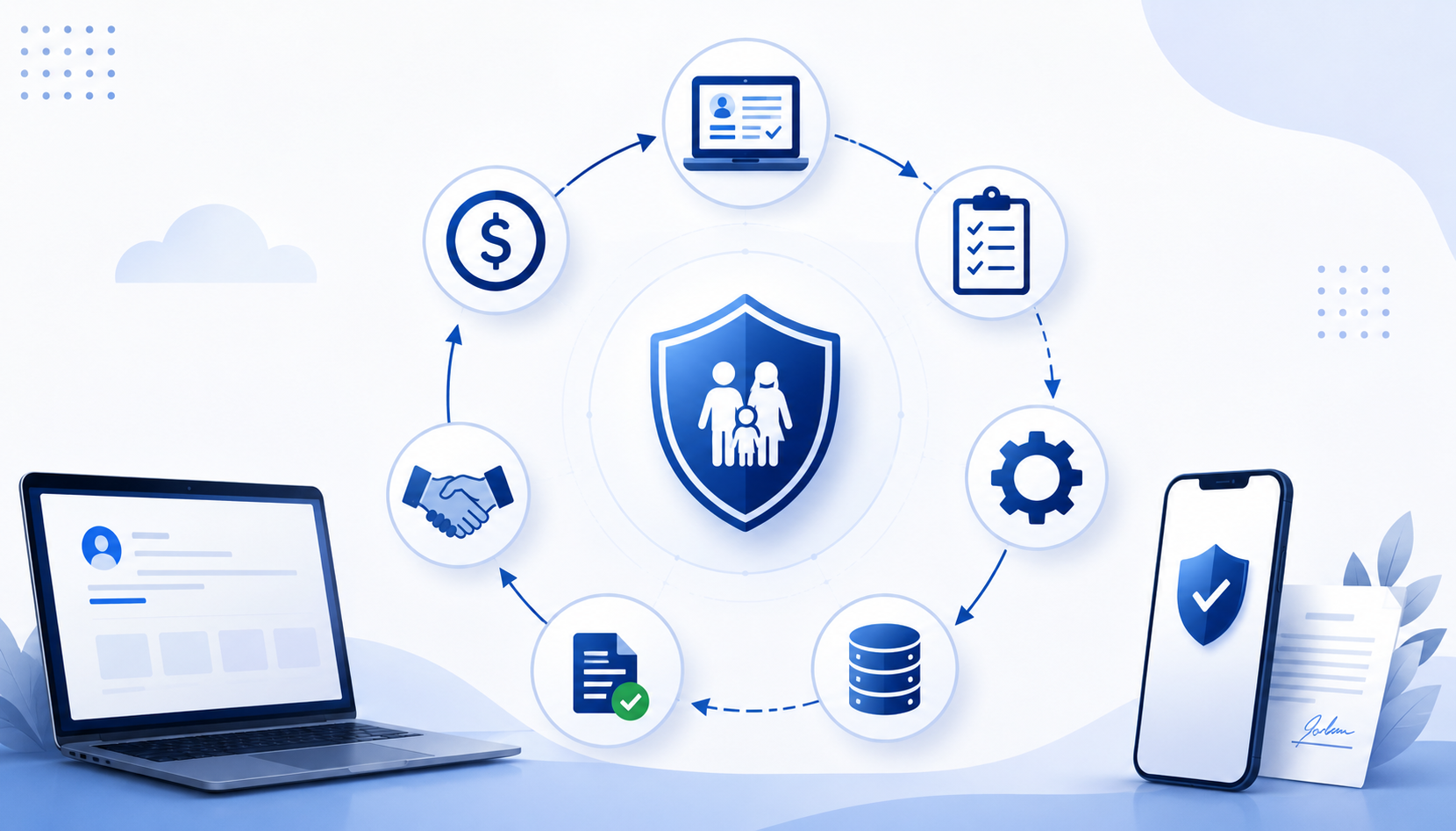
Straight Through Processing refers to the automated, end-to-end handling of a life insurance application — from submission to policy issuance — without any manual intervention.
The application data flows directly through each system:
- e-application
- underwriting rules engine
- data verification
- approval
- policy delivery
In a true STP environment, a clean application submitted by an agent can result in an issued policy within minutes.
- No paper
- No phone calls
- No underwriter touching the file
This is made possible through tightly integrated Life insurance underwriting systems that communicate in real time using data standards like ACORD XML.
Why Does STP Matter So Much Right Now?
Consumer expectations have shifted dramatically. People buying life insurance today expect a digital, fast experience — similar to what they get when applying for a credit card or opening a bank account online.
Carriers that still rely on manual underwriting for standard-risk cases are losing ground.
Here is why STP changes the equation:
1. Faster Issuance = More Business Closed
Every day an application sits in a queue is a day the applicant might change their mind.
STP compresses the issuance timeline from weeks to hours — or even minutes for simplified issue products.
2. Reduced NIGO Rates
“Not In Good Order” applications are one of the biggest operational headaches in life insurance.
STP, combined with smart Life insurance e-application platforms, validates data at the point of entry — catching errors before the application ever reaches the carrier.
3. Lower Operating Costs
Manual underwriting and case management are expensive.
When clean cases flow through automatically, underwriters can focus their attention on complex, higher-risk cases where human judgment actually adds value.
4. Better Agent Experience
Agents want to know their cases are moving.
STP enables real-time status updates, fewer follow-up calls, and faster commissions — all of which improve agent retention and loyalty.
What Does an STP-Enabled Workflow Look Like?
A typical STP workflow in life insurance looks like this:
- Agent submits application through a digital e-app platform
- Data is validated and formatted automatically using ACORD standards
- The application hits the carrier’s underwriting rules engine and runs through automated decisioning
- Third-party data sources (MIB, prescription history, motor vehicle records) are pulled in real time
- If the case meets straight-through criteria, a decision is made automatically
- Policy is issued and delivered electronically via eDelivery
- Commission is calculated and posted via Commission accounting software
The whole process can happen in under 15 minutes for eligible cases.
What Percentage of Cases Can Go Straight Through?
Not every case qualifies.
Complex medical histories, large face amounts, and older applicants often still require underwriter review.
However, industry estimates suggest that 30% to 60% of life insurance applications at carriers with modern infrastructure can achieve STP — depending on the product line and risk appetite.
For simplified issue and final expense products, that percentage can go even higher.
The Technology Stack Behind STP
Achieving true STP requires several systems working in harmony:
- A modern Policy administration system (PAS) that can receive and process data without manual re-entry
- An automated underwriting rules engine
- Real-time third-party data integrations
- A compliant eDelivery mechanism
- API-based connectivity across all platforms
Without this integrated stack, STP remains out of reach — no matter how good any individual system is.
Final Thoughts
Straight Through Processing is not just an operational efficiency play. It is a strategic differentiator.
Carriers that invest in STP-capable infrastructure today are building the foundation for:
- faster growth
- lower costs
- stronger agent relationships
If your organization is still processing clean applications manually, it is worth asking:
How many cases — and how much business — are you losing while the paperwork moves?